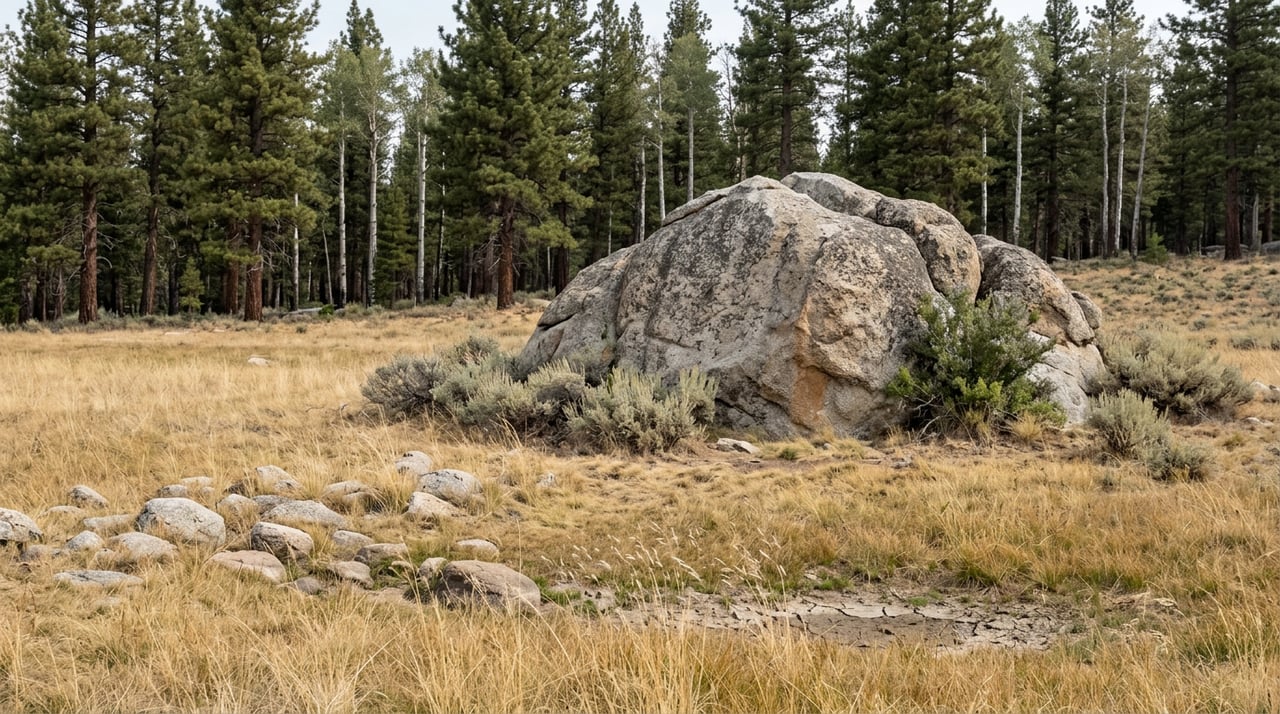
Two parcels came up near Sierraville this year within a few weeks of each other. Both were around twenty acres. Both backed up to open Sierra Valley land with the kind of quiet, no-neighbors privacy that draws buyers out from Reno and the Bay Area in the first place. One listed for $328,000. The other for $245,000. A buyer comparing them side by side would naturally ask which one is the better deal per acre.
That's the wrong question. The number that actually decides what you can do with either parcel isn't on the listing sheet at all. It's a casing diameter, seven inches, and it lives in a groundwater ordinance most buyers never open.
The County Isn't the One Who Says Yes
If you're buying raw land almost anywhere else in California, the well permit process runs through the county building department and that's the end of it. Sierraville sits inside the boundaries of the Sierra Valley Groundwater Management District, a district created by state special legislation back in 1980, long before California's statewide groundwater law existed. Under Sierra County's own code, a well permit inside the district's boundaries cannot be issued by the county building official until the district itself has signed off first.
That means the county isn't the gatekeeper here. It's the second signature, not the first. Before you ever get to a county permit, your well plans have to clear a separate review by a district board that meets specifically to evaluate applications for new, repaired, or deepened wells within Sierra Valley.
Domestic Wells and Everything Else
The district's rule, adopted as Ordinance 18-01 and amended as recently as March 2024, draws a hard line between two categories of well. A well is classified as high-capacity if it pumps more than two acre-feet a year, roughly 1,800 gallons a day, or if it's built with casing larger than seven inches in outside diameter. Anything at or under that casing size, built for ordinary household use, falls outside the high-capacity prohibition entirely.
For most buyers planning a single home and a normal domestic water supply, this is good news. A standard residential well typically won't trip the high-capacity threshold, and the ordinance is explicit that domestic wells built with seven-inch casing or smaller aren't touched by the district's prohibition on new high-capacity wells.
The complication shows up for anyone planning something bigger. Irrigation for pasture, a second structure with its own supply, a small hobby ranch, anything that pushes past that 1,800-gallon-a-day threshold moves your well into a different regulatory category, one that includes a mapped area where new high-capacity wells are restricted outright. The district keeps that map on file as part of its technical guidelines. Whether a specific twenty-acre parcel sits inside or outside that restricted zone isn't something you can tell from a listing photo or a plat map. It's a question you ask the district directly, before you write an offer, not after.
Here's how the two categories actually diverge:
| Domestic well (≤7" casing) | High-capacity well (>7" casing or >2 acre-ft/yr) | |
|---|---|---|
| District review required | Yes, but not subject to the prohibition | Yes, and may fall inside a restricted area |
| Typical use | Single household | Irrigation, livestock, multiple structures |
| Repair or replacement | Generally straightforward | Must match existing pumping capacity and location under district rules |
| Timeline risk | Low | Higher, may require variance hearing if denied |
That variance path exists for a reason. When the district has denied or revoked a permit application over well spacing or the prohibited area, the applicant has thirty days to appeal in writing and request a public hearing before the board. A variance is only granted if the board finds unusual circumstances and confirms it won't interfere with existing wells or the basin as a whole. That's not a rubber stamp. It's a real hearing with a real chance of going either way, and it adds weeks, sometimes longer, to a timeline a buyer might have assumed would move at county speed.
Why the District Is Paying Closer Attention Right Now
None of this is theoretical caution. The district has been actively managing the basin's supply, and the pace picked up heading into this year. At the board's February 2026 meeting, the district's annual report showed that agriculture accounted for 89 percent of the groundwater extracted from the basin in 2024. Gus Tolley, the hydrogeologist working with the district's consulting team, told the board the basin can absorb roughly six thousand to seven thousand acre-feet of groundwater reduction per year before it starts causing long-term harm to water levels and groundwater-dependent ecosystems.
The district isn't just watching. It's building tools to manage the balance. Larry Walker Associates, which handles basin management for the district, purchased portable well sounders that landowners can use at no cost to monitor their own water levels, expected to be ready within a couple of months of that February meeting. The district has also been running recharge projects, diverting winter high-flow water into the ground during qualifying storm windows. One diversion in early January 2026 moved about twelve acre-feet into the aquifer. And on February 19, 2026, the California State Water Resources Control Board announced that it had issued the Sierra Valley Groundwater Management District a new five-year permit for these recharge diversions, part of a program that has cut the state's typical recharge permit approval time down to about four months from what used to take up to a year.
Put together, this is a district that's actively tightening its data and its tools at the same time land near Sierraville keeps drawing interest. That combination is exactly why the well question deserves attention before escrow, not during it.
What to Actually Check Before You Offer
The practical version of all this comes down to a short list, and it's worth working through before you're under contract with a clock running.
- Ask the seller or listing agent whether the parcel has an existing well, and if so, request the well completion report on file with the Department of Water Resources. It will show casing size and pumping capacity.
- If there's no well yet, contact the Sierra Valley Groundwater Management District directly and ask whether the parcel falls inside the mapped area restricted for new high-capacity wells, and confirm what casing size keeps a planned domestic well outside the prohibition.
- Don't assume septic and well are handled by the same office. Septic and leach field permits in Sierra County run through the Environmental Health Department under the county's Local Agency Management Program, a separate process from the well review. Local firms like Bonanza Septic handle perc tests and inspections tied specifically to real estate transactions, and getting that piece scheduled early avoids a bottleneck at the end of escrow.
- If your plans involve anything beyond a single household, irrigation, a second dwelling, livestock watering, ask early whether that pushes your well into high-capacity territory. That's the point where a straightforward purchase can turn into a variance hearing.
- Build the district's review timeline into your own expectations for how long the process will take, rather than assuming county-only pace.
None of this means land near Sierraville is a harder buy than it looks. Most single-home domestic wells clear the process without incident. It means the price per acre on the listing sheet was never the whole story, and the buyers who ask about casing size before they ask about closing costs are the ones who don't get surprised in week six of escrow.
A Few Questions Worth Asking Directly
Does this apply if the property already has a working well? Existing wells aren't exempt from district oversight, but repairing or replacing one is generally more straightforward than a new application, provided the replacement doesn't exceed the original well's pumping capacity and stays close to the original location under the district's rules.
Is this only a concern for agricultural buyers? No. The district review applies to any well within its boundaries, agricultural or residential. The distinction that matters most for a typical home buyer is the casing size and pumping rate, not the intended use.
How do I find out if my specific parcel is in a restricted area? The clearest path is contacting the Sierra Valley Groundwater Management District directly and asking about the specific parcel number. The district ordinance and technical guidelines are public, but the mapped restricted area is easiest to confirm with the district itself rather than interpreted secondhand.
Land near Sierraville still offers something hard to find elsewhere in the Sierra: real acreage, real privacy, and a straightforward path to a domestic well for most buyers. The point isn't to avoid the process. It's to ask the right question before the offer goes in, not after the inspection period has already started ticking down.
If you're looking at acreage in the Sierra Valley and want a second set of eyes on what a specific parcel's water situation actually looks like before you write an offer, Liz Joy and the team know the local process and the people to call. Let's Connect.